At a classical music concert once, I had an experience that’s probably familiar to many. Sitting quietly, I gradually became aware of a little tickle in my chest. As the minutes went by, the tickle grew. It was clear my respiratory system wanted me to cough, but the music was quiet, and coughing would ruin the atmosphere. I resisted.
As it turns out, what I was using—the ability to suppress a cough—has an interesting evolutionary history.
Coughs themselves go way back. Land vertebrates such as humans are active animals. As a result, their bodies need constant access to oxygen. To provide this access, they have evolved lungs. And as you might imagine, keeping those lungs functioning and free of obstruction is critical. All land vertebrates seem to have some version of a cough, a forceful expulsion of air from the lungs to deal with obstruction, irritation or infection. This suggests coughs go back many hundreds of millions of years.
The mechanics and anatomy of the cough have been worked out in greatest detail in mammals (our closest relatives among the land vertebrates). The control of coughing there is often described as a reflex, an automatic response to irritation or obstruction. The basic set up in humans is illustrated below, but also works the same way for other mammals. Sensory nerves detect obstruction or irritation in the airways and send signals (orange arrow) to the brainstem (dark blue). A “cough center” in the brainstem then sends signals (longer orange arrow) through various nerves to the muscles of the diaphragm and abdominal wall. These lead to rapid contraction and expulsion of air from the lungs. This arrangement, including the muscles, nerves, and brainstem cough center is shared among mammals, and thus probably evolved more than 100 million years ago.
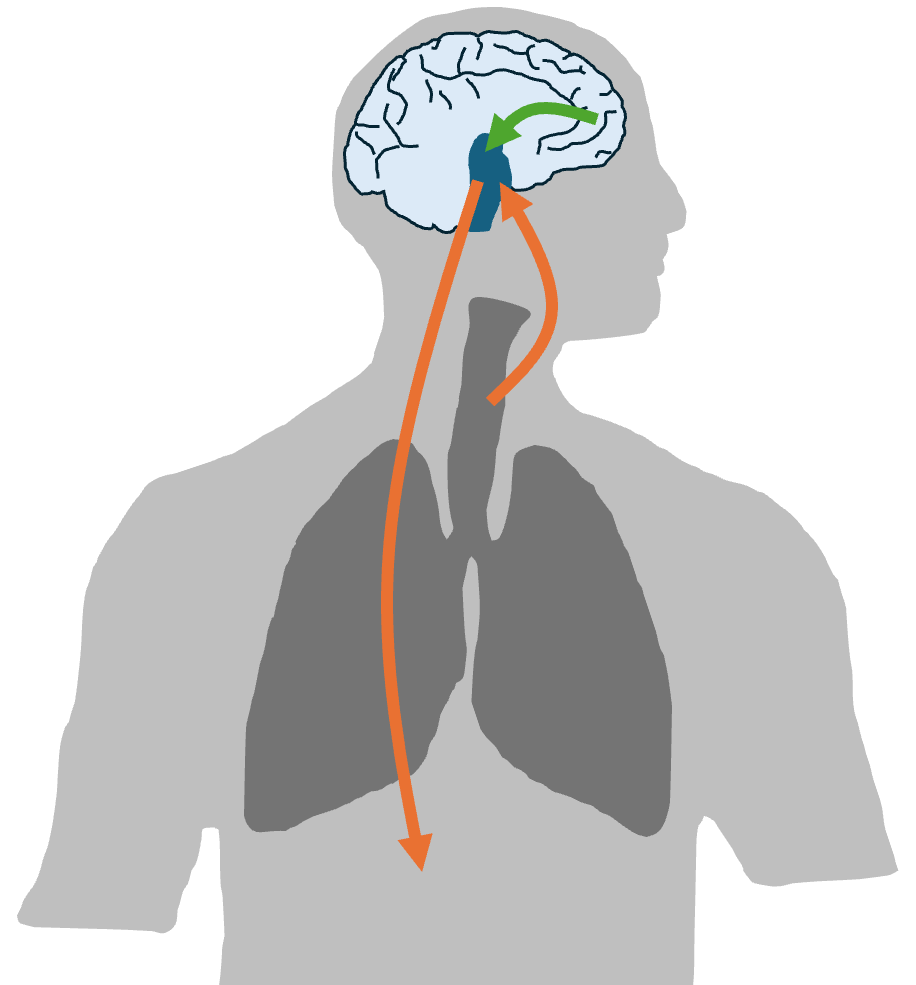
Illustration of the control of coughing, see text for details.
The similarities between human coughing and coughing in other mammals has been useful for medical research. Different types of stimuli can trigger coughs, ranging from physical obstruction to chemical irritation. Animal studies have allowed researchers to identify the cellular receptors involved in detecting these stimuli (interestingly, one of them is the TRPV1 receptor that is also involved in detecting spiciness in food).
But there is one aspect of coughing in humans that differs somewhat from other mammals: the ability voluntarily control it. The fact that such control exists can be demonstrated in various ways. One of the most dramatic is the placebo effect in studies of cough suppressants. It has been found that when subjects take a placebo, that is something that they believe to be a treatment, but which does not in fact contain a drug, they nevertheless cough substantially less. The conscious knowledge of taking a pill is able to influence the cough system.
This is due to connections from other parts of the brain. The green arrow in the figure represents connections going from cortex into the brainstem. It is thought that such connections are more substantial in humans compared with other animals. This implies they have arisen recently in human evolution.
It’s not known for sure why humans evolved more voluntary control of coughing, but it’s tempting to think it has to do with speech. Speech requires exquisite voluntary control of the respiratory system, and maybe when this was evolving evolution also extended more voluntary control over coughing.
While we have some voluntary control over our coughs, I can tell you that control has its limits. At the classical concert, my efforts at cough suppression might have made things worse. I kept myself quiet for a while, but eventually I could no longer stop it. And at that point, it wasn’t just one or two little hacks, but a loud and prolonged fit of coughing.
 Eliot Bush
Leave a comment